Search used to have one reader: a person scanning a page of blue links. AI search has two.
The first is still a person, but now they read a generated answer in ChatGPT, Gemini, Google AI Mode or Perplexity, and may never visit your site at all. The second is new: an AI agent that browses, compares and sometimes fills in forms on someone's behalf. Both decide whether your business gets mentioned, recommended or skipped.
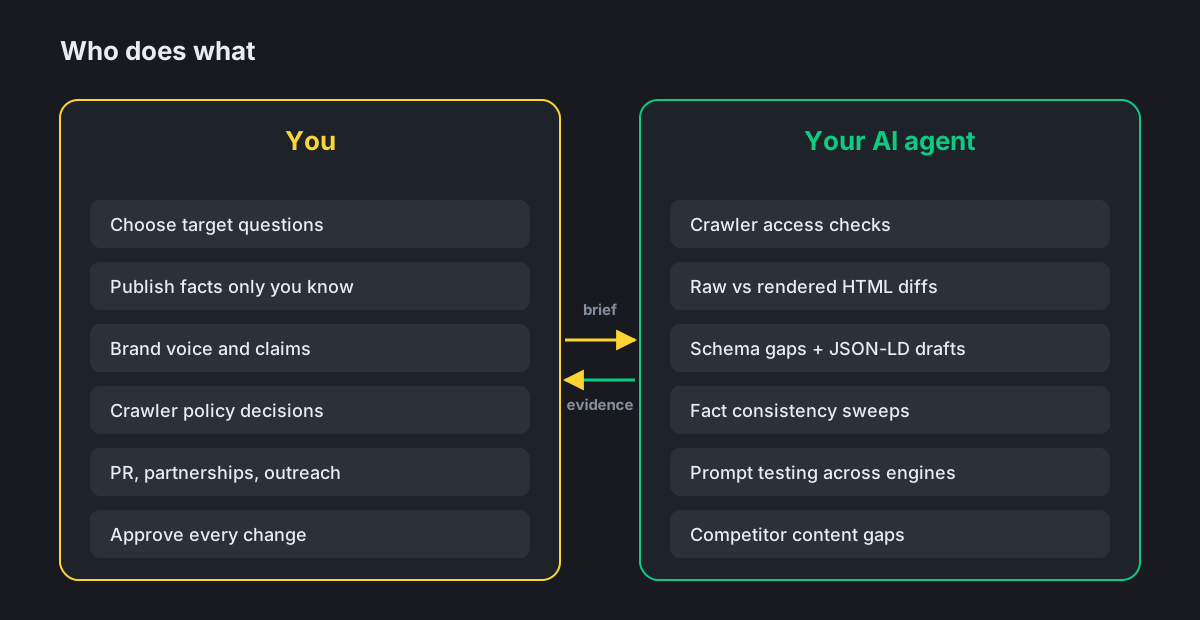
This guide covers what it takes to be visible to both. It also splits the work in two: the judgment calls that belong to you, and the repetitive checking you can hand to an AI agent of your own.
Start with the fundamentals (they still do most of the work)
There is a lot of noise about special tricks for AI search. Google's own guidance on its generative AI features is blunt: the basics of good SEO still apply. Pages need to be indexed and eligible to appear with a snippet, and Google says no special AI files, content "chunking" or AI-specific rewriting are required for its AI features.
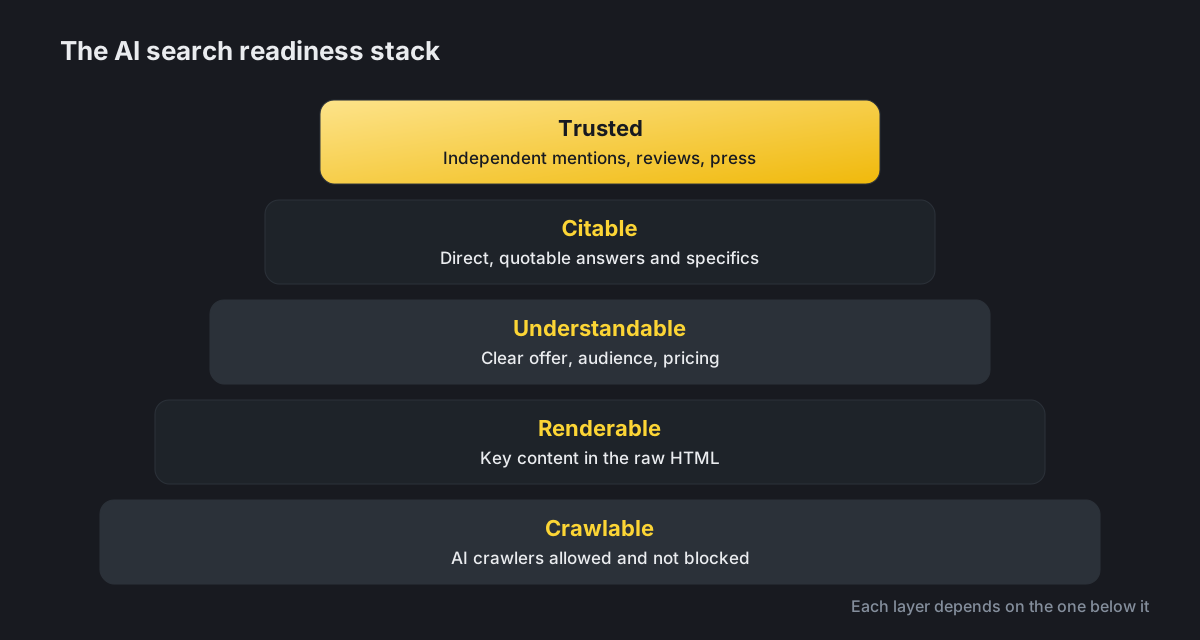
Other AI engines differ in the details, but they share the same starting point. An assistant cannot recommend what it cannot reach, read or trust. Each layer of the stack above depends on the one beneath it:
| Layer | The question it answers | What breaks it |
|---|---|---|
| Crawlable | Can AI crawlers reach the page? | robots.txt blocks, firewall/CDN bot rules, login walls |
| Renderable | Is the content in the HTML the crawler receives? | Text that only appears after JavaScript runs, content inside images or PDFs |
| Understandable | Is it clear what you do, for whom, at what price? | Vague copy, missing product and pricing pages, inconsistent naming |
| Citable | Is there a specific, quotable answer on the page? | Fluffy intros, answers buried deep, no data or definitions |
| Trusted | Do other sources back up what you say? | No reviews, no press, no independent comparisons or discussion |
Most visibility problems sit in the bottom two layers, and they are the cheapest to fix.
Part 1: What you should own
Some work needs a human who understands the business, the market and the brand. Don't delegate these.
Decide which questions you want to win
AI visibility is won question by question. List the 20 to 50 questions a real buyer asks before choosing a company like yours: "best [category] for [type of customer]", "[your brand] vs [competitor]", "is [your brand] worth it", "how much does [service] cost in [city]". This list drives everything else, from content to monitoring.
Publish the facts nobody else can
AI answers reward specifics: prices, plan limits, integrations, locations, turnaround times, original numbers. You are the only authoritative source for these. Put them on clear, dedicated pages and keep them current. A stale pricing page gets repeated by an assistant just as confidently as a current one.
Write answers, not warm-ups
Open important sections with a direct, self-contained answer in one or two sentences, then add the detail. That gives an assistant a clean passage to quote and gives a human reader the answer straight away.
Earn your reputation off-site
Independent mentions carry weight that your own pages cannot. Ahrefs' study of 75,000 brands found that branded web mentions correlated far more strongly with visibility in AI answers than backlinks did. Reviews, industry press, comparison articles, podcasts, YouTube videos and genuine community discussion are where that reputation is built, and it takes judgment about where your buyers actually listen.
Set the rules for AI crawlers
Deciding which bots may use your content is a business decision. For example, OpenAI lets you allow its search crawler (OAI-SearchBot) while blocking its training crawler (GPTBot). Make that call deliberately, then let an agent check that your settings match it.
Part 2: What you can hand to your AI agent
AI agents with browsing, file access or a terminal are very good at repetitive, checkable work. Give them clear instructions and a definition of "done", and review what they produce.
| Task | Hand it to an agent? | Example instruction |
|---|---|---|
| Crawler access check | Yes | "Fetch robots.txt for our domain and list every rule affecting OAI-SearchBot, GPTBot, ClaudeBot, PerplexityBot and Googlebot." |
| Rendering check | Yes | "For these 10 URLs, compare the raw HTML with the rendered page and list any key text that only appears after JavaScript runs." |
| Structured data audit | Yes | "List pages missing Organization, Product or FAQ schema and draft the JSON-LD for review." |
| Fact consistency sweep | Yes | "Find every page that mentions our prices or plan limits and flag any that disagree with /pricing." |
| Prompt testing | Yes, with care | "Ask these 30 buyer questions, record whether we are mentioned, who else is, and which sources are cited." |
| Competitor content gaps | Yes | "For each question we lose, summarize what the cited pages cover that ours don't." |
| Choosing target questions | No: you | The agent can suggest a list; you decide what matters commercially. |
| Brand voice and claims | No: you | Agents draft; a human approves anything published under your name. |
| Outreach and PR | No: you | Relationships and judgment don't automate well. |
Ground rules for working with agents: give them read-only access wherever possible, keep credentials out of the chat, ask for evidence (URLs, raw output) rather than conclusions, and review every change before it goes live.
Making your site agent-ready
AI agents don't just read pages; they navigate them. A few practical habits make that easier:
- Use real links and buttons. Navigation that only works through scripted click handlers is harder for agents to follow.
- Label forms clearly. Visible labels, sensible field names and plain error messages help an agent complete a quote request or booking correctly.
- Keep key facts in text. Prices in images and specs in PDFs are easy for people to read and awkward for machines.
- Be careful with llms.txt claims. Google states that its Search, including AI Overviews and AI Mode, does not use llms.txt, and that having one neither helps nor harms you there. Separately, Chrome's Lighthouse has an experimental agentic-browsing audit that checks for it. Treat llms.txt as a low-cost courtesy to some AI tools and agents, not as a ranking lever.
A 30-day plan
| Week | You | Your agent |
|---|---|---|
| 1 | Pick 20–50 target questions; set your AI crawler policy | Crawler access check, rendering check on top 20 pages |
| 2 | Fix or write the pages for your most valuable questions | Fact consistency sweep; draft missing schema |
| 3 | Start one off-site push (reviews, a guest article, a comparison listing) | Baseline prompt test across ChatGPT, Gemini and Perplexity |
| 4 | Review results, choose next month's priorities | Repeat the prompt test and report what changed |
Key takeaways
| Two audiences | People reading AI answers and agents acting for them. Optimize for both. |
| Basics first | Crawlable, renderable, understandable, citable, trusted: in that order. |
| Off-site matters | Independent mentions correlate with AI visibility more strongly than links. |
| Delegate checking | Agents are great at audits and monitoring; keep strategy and claims human. |
| No silver bullets | No file, tag or trick guarantees inclusion in AI answers. |
Further reading
- Where Does ChatGPT Get Its Answers? A Plain-English Guide for Businesses
- How to Rank on ChatGPT: What Actually Works (Based on Data)
- How to Monitor Brand Mentions in ChatGPT
- The ChatGPT Traffic Playbook: How to Track, Measure, and Grow
- AI Visibility Audit: How to Measure Your Brand's Presence in AI Search
Want the checking done for you? Run a free AI visibility audit of your site, or see Echorank plans for scheduled AI answer tracking, AI crawler analytics and site crawling in one place.
Sources
- Google Search Central: Optimizing your website for generative AI features on Google Search
- Google Search Central: AI features and your website
- OpenAI: Overview of OpenAI crawlers
- Ahrefs: Top brand visibility factors in ChatGPT, AI Mode and AI Overviews (75k brands)
- Search Engine Journal: Google's llms.txt guidance depends on which product you ask
Editor: Frederic Desjardins - Echorank