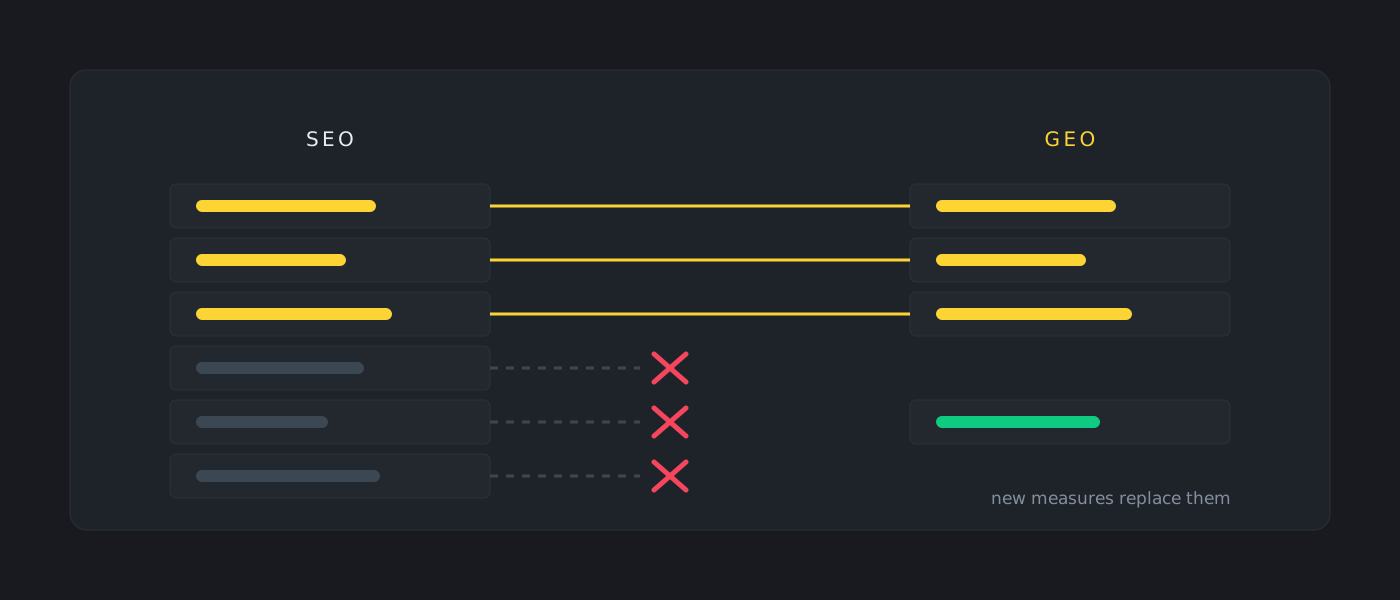
Most of your SEO measurement survives the move to answer engines untouched. Organic sessions, conversions, assisted conversions, crawl coverage, index coverage and Core Web Vitals all still mean exactly what they meant, because they describe your site rather than a search results page. Three things do not carry over: rank position, which has no equivalent in a composed answer; impressions, which an answer engine does not report; and click-through rate, which quietly inverts — an answer good enough to satisfy the reader without a click reports as a failure in a CTR column.
Getting that boundary right matters more than adopting any particular new metric, because the metrics that mislead are more dangerous than the ones that are simply missing.
What carries over unchanged
Anything measured on your own property still works. Sessions, engaged sessions, conversion rate, revenue per session, page-level engagement, index coverage and site speed are all measurements of your site, and no change in how people arrive alters what they mean. The same is true of the technical health metrics: a page that is slow or uncrawlable is worse off on both surfaces, not just one.
This is worth stating plainly because a certain amount of GEO commentary implies the whole measurement stack is obsolete. It is not. The part of your reporting that describes what happens after arrival is completely unaffected.
What breaks: rank position
Rank position has no meaning in an answer engine because there is no ordered list to hold a position in. The engine composes one response and cites a handful of sources; two runs of the same prompt can cite different sources in a different order. There is no slot four to occupy and no stable artifact both you and your competitor can point at.
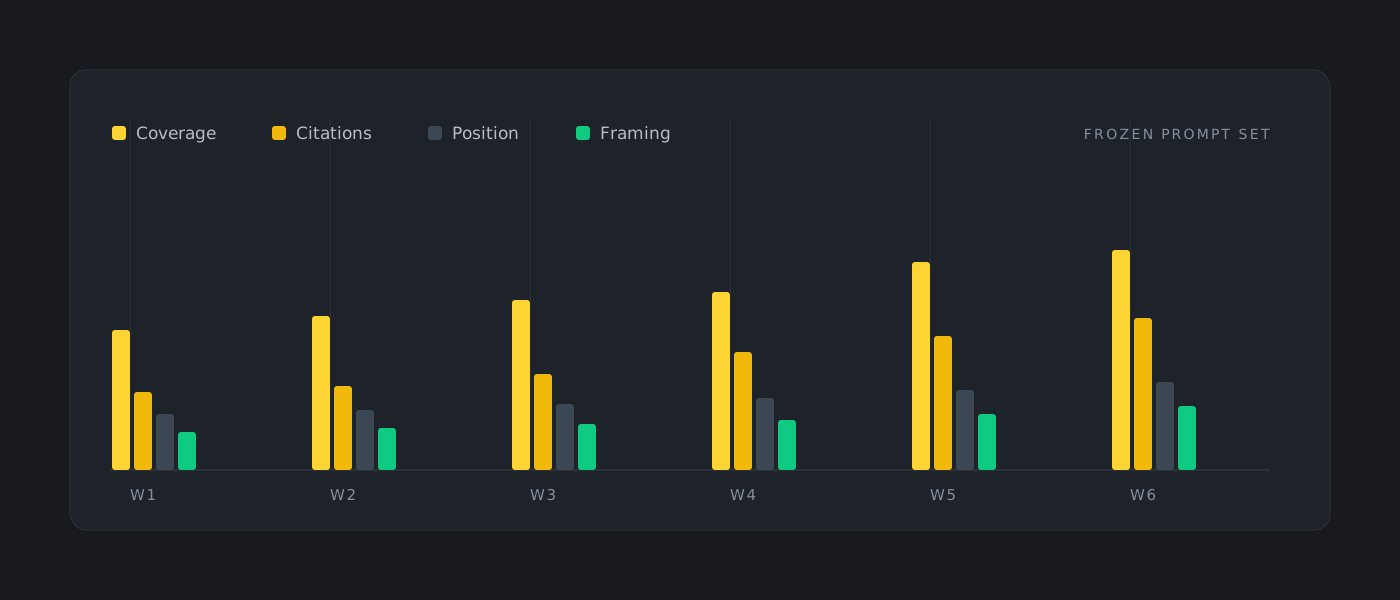
The replacement is not a rank but a rate: across a frozen set of prompts, how often do you appear, and how much of the cited sourcing is yours. That shift — from an ordinal to a frequency — is the single biggest conceptual change, and how to measure AI search visibility walks through building the prompt set and running it cleanly enough for the rate to be trustworthy.
What misleads: impressions and click-through rate
Impressions have no counterpart at all: answer engines do not publish an impression count, and nothing you can observe from outside reconstructs one. That is a gap, and a gap is honest — you simply do not have the number.
Click-through rate is the dangerous one, because it keeps reporting. As more queries are answered in place, the same underlying demand produces fewer clicks against a search surface that may still be showing you. CTR falls. Read as a performance metric, that reads as "our result got worse". It may equally mean the answer above it got better at satisfying the reader — which, if you were the source it was built from, is influence you had and cannot see.
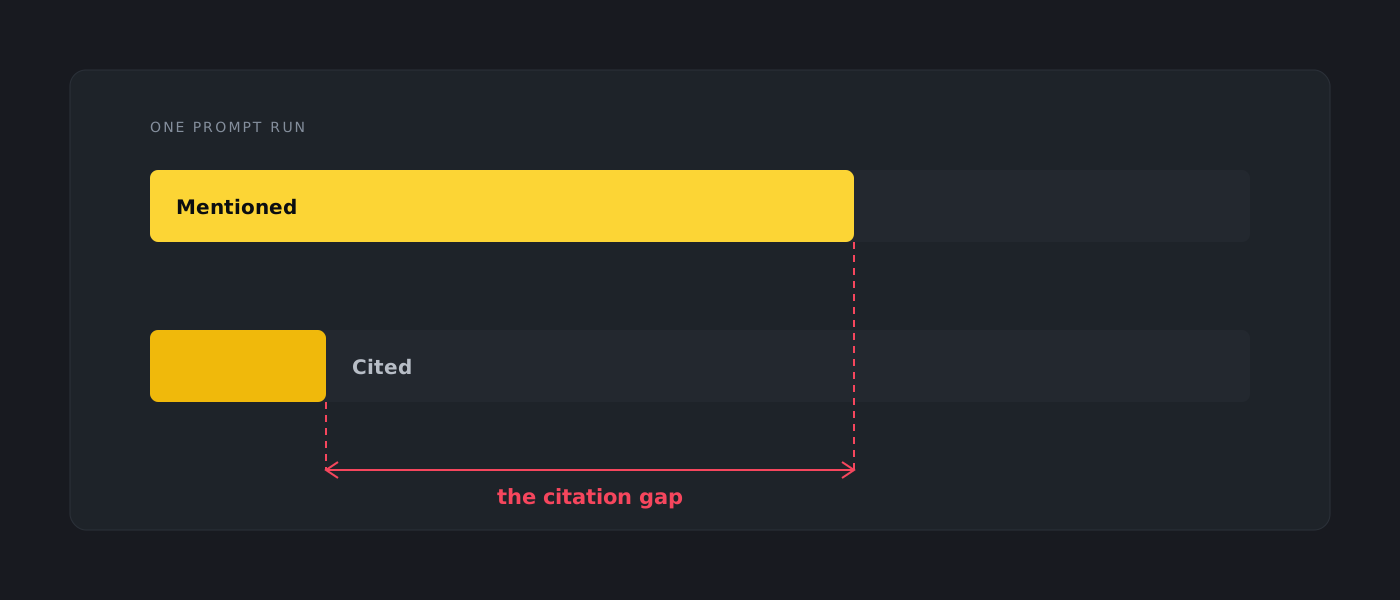
Here is the practical consequence, stated as an observation rather than a law: a falling CTR alongside a flat or rising citation share is not a decline. It is the same visibility arriving through a surface that does not click. Treating it as a decline is how teams end up cutting the content that was working. Citation share is the number that keeps this readable, and finding your AI citation gap covers how to produce it from the same run that gives you coverage.
| SEO metric | Status in GEO | What to use instead |
|---|---|---|
| Organic sessions | Carries over | Unchanged |
| Conversions | Carries over | Unchanged |
| Index and crawl coverage | Carries over | Unchanged |
| Rank position | No equivalent | Prompt coverage across a frozen set |
| Impressions | Not observable | Nothing — record the gap honestly |
| Click-through rate | Misleads | Citation share, read beside CTR |
| Share of voice | Partial | Share of cited sources per prompt |
| Backlinks | Carries over, differently | Third-party corroboration of your claims |
Backlinks, reframed
Links still matter, and the reason has shifted somewhat. In classic SEO a link is a vote that flows authority. On an answer surface, an independent page that states the same fact you state is corroboration — a second source an engine can reconcile yours against. That reframing changes what a good link looks like: a mention in a page that repeats your specific claim is worth more than a higher-authority link that says only that you exist.
We hold this loosely. It is consistent with what we see in citation patterns and it is not something we have isolated experimentally, so treat it as a working hypothesis rather than a finding.
Report them side by side
Our recommendation is one report with two clearly separated panels: an SEO panel with sessions, rankings and conversions, and a GEO panel with prompt coverage, citation share, answer position and framing. Same page, same cadence, no arithmetic between them.
The temptation is to blend the two into a single "visibility score" because a single number is easier to present. It is also unreadable: when it moves, nobody can say which surface moved, and that is the only question the report exists to answer. A blended score that fell because CTR fell — while citation share rose — will send a team to fix something that is not broken.
A reporting checklist
- Keep every on-site metric exactly as it is. Nothing about them changed.
- Remove rank position from any claim about total visibility; keep it for the ranked surface.
- Record impressions as unavailable rather than approximating them.
- Never read CTR alone. Pair it with citation share in the same view.
- Report SEO and GEO in separate panels, never blended into one score.
- Use one frozen prompt set for the GEO panel, versioned rather than edited.
- Annotate the report with deliberate site changes and their dates.
- Review the pairing quarterly — the surfaces are moving, and the mapping above will need revisiting.
Where to start
If you are building the GEO panel for the first time, start with the prompt set rather than the dashboard: how to measure AI search visibility is the method, and everything above is what to do with the numbers once you have them. If your first run comes back near zero, do not conclude anything yet — run a free GEO audit first to confirm that AI crawlers can reach and parse your pages at all, because a robots.txt rule nobody has read since 2021 produces the same numbers as a content problem and takes ten minutes to rule out.
Questions fréquentes
Should I stop tracking rankings?
No. Ranked results still exist, still receive clicks and still convert, and a channel that sends real traffic deserves real reporting. What changes is that rankings stop being a complete picture of visibility, so they belong beside GEO measures rather than standing in for them.
Can I combine both into one visibility score?
You can, and we recommend against it. The two surfaces move for different reasons and on different timescales, so a blended number goes up or down without telling you which half caused it — which is the one thing the report existed to answer.
Does AI search traffic show up in analytics at all?
Some of it does, as referrals from assistant domains, and that share is worth watching. But an answer that satisfies a reader without a click leaves no analytics trace at all, so referral volume is a floor on your influence rather than a measure of it.