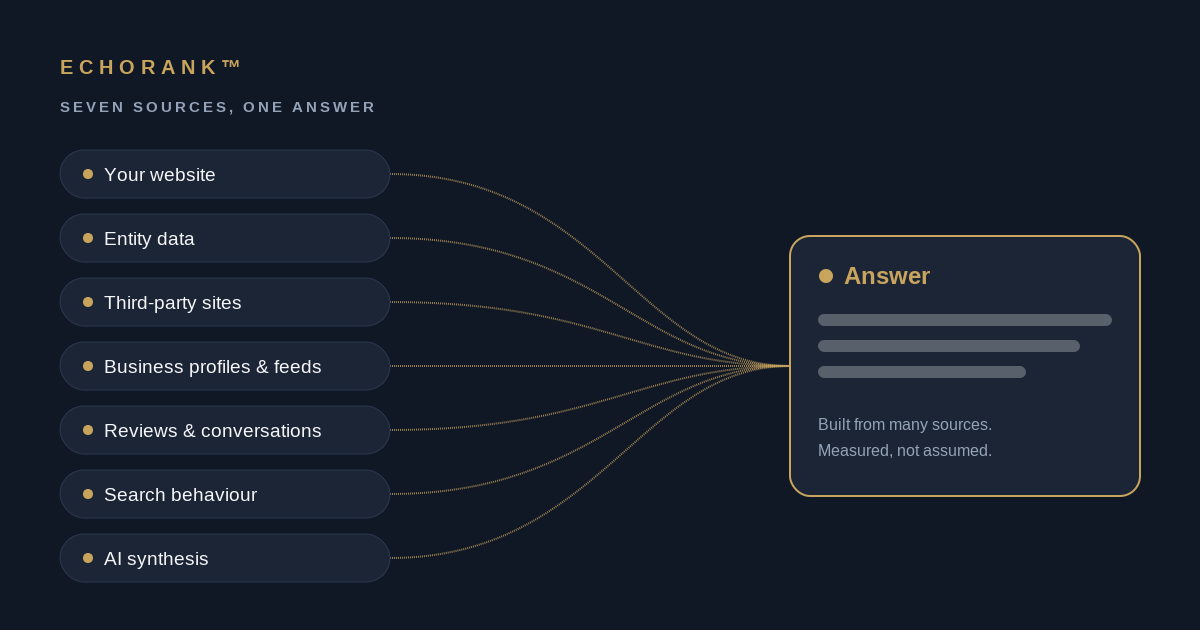
Google and AI assistants such as ChatGPT and Gemini do not have one source of truth about your business. They assemble answers from seven kinds of sources: your own website, structured entity data, independent websites, business profiles and data feeds, customer reviews and public conversations, search behaviour, and the AI model's own synthesis of everything it retrieved or learned. You can improve most of these directly. What you cannot do is dictate the final answer, which is why visibility now has to be measured, not assumed.
This guide walks through each source, what you can do about it, and how Echorank helps you see the result.
Why rankings no longer tell the whole story
For years, visibility meant your position in Google's results. That still matters. But a business can rank well in Google and be missing from the recommendation an AI assistant gives to the same customer.
So the questions have widened:
- Can search and AI crawlers reach your most important content?
- Do they understand what your business does?
- Do AI assistants recommend you, and is what they say accurate?
- Which websites shape how AI describes you?
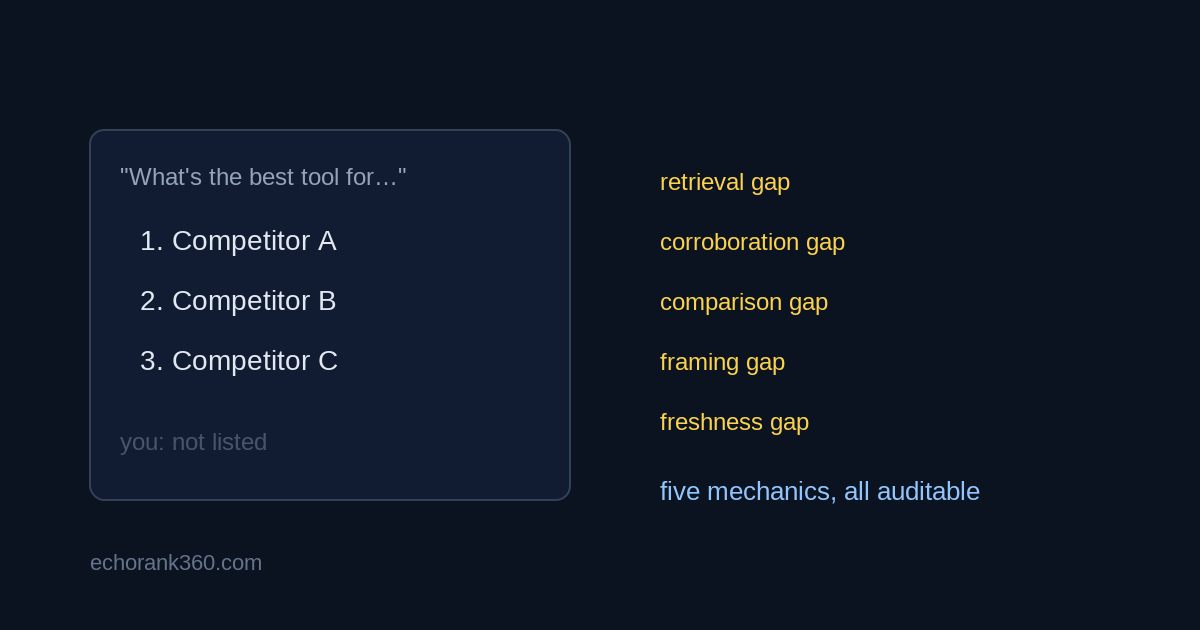
- Where do competitors appear and you do not?
Echorank is built to answer these together: technical SEO, AI visibility monitoring, brand analysis and reputation management in one place.
The seven sources at a glance
| Source | Examples | What you can do |
|---|---|---|
| Your website | Pages, articles, landing pages | Fix technical access, publish clear content |
| Entity data | Schema markup, knowledge bases | Make your identity consistent |
| Third-party sites | Industry press, directories, reviews of you | Earn credible coverage |
| Business profiles and feeds | Google Business Profile, product listings | Keep details accurate |
| Customer voices | Reviews, forums, discussions | Manage reputation honestly |
| Search behaviour | Queries, interaction patterns | Serve the visitor's intent |
| AI synthesis | Summaries and recommendations | Monitor and correct |
1. Your website
Your site is the main thing crawlers use to understand you. They discover pages, read the content and follow internal links. Publishing something does not mean it can be reached or understood.
The usual blockers:
- robots.txt rules or noindex tags that shut out pages by mistake
- broken internal links and weak site structure
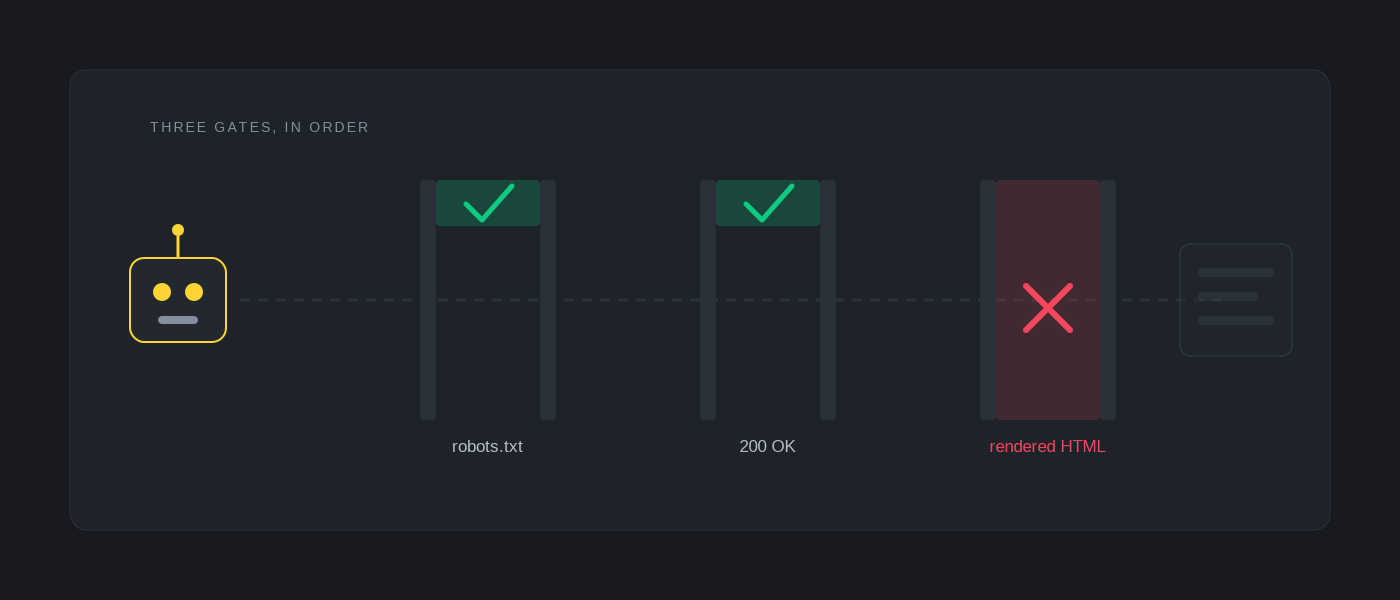
- content that only appears after JavaScript runs
- wrong canonical tags
- missing or inaccurate structured data
- key facts hidden behind tabs, accordions or forms
With Echorank: Nosy Bat™ crawls your site and lists technical problems. AI Lens compares your raw HTML with the rendered page, so you can see what a crawler with limited JavaScript support would miss. The AI Visibility audit scores how ready the site is for AI discovery. For the full method, see Make your site readable to AI crawlers.
Fix access before you write more content. New pages do not help if the existing ones cannot be read.
2. Entity data: how engines know who you are
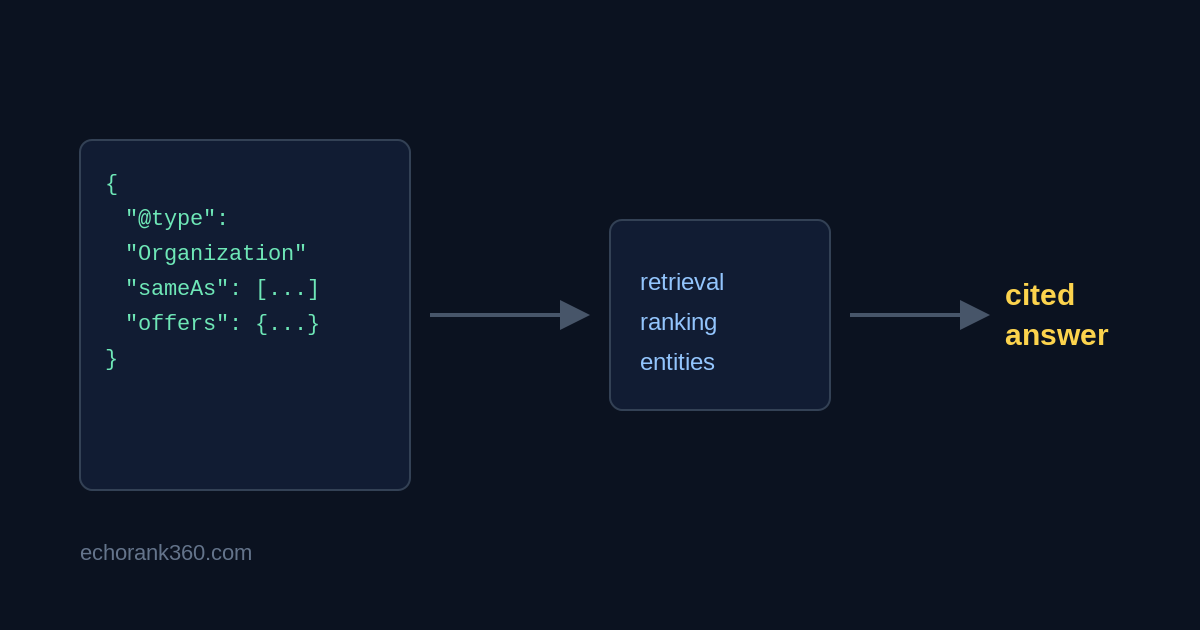
Search engines do more than match keywords. They identify entities (organisations, people, products, places) and the relationships between them. Google's Knowledge Graph is the best-known example, and AI systems use similar context.
The clearer and more consistent your identity is across public sources, the easier it is to tell you apart from similarly named businesses.
A short checklist:
- one business name, used the same way everywhere
- accurate contact details
- plain descriptions of what you sell
- a real About page, with named authors and experts
- appropriate structured data (see Schema markup for AI answers)
- third-party profiles kept up to date
Structured data helps systems that support it. It does not guarantee rankings or AI citations.
With Echorank: Custom Prompts stores each AI assistant's full answer to the questions you track, so you can compare the identity you intend with the one they present.
3. Third-party websites
Your website is what you say about yourself. Other sites are what the rest of the web says.
Take two companies with similar services. The first has a polished website and little else. The second has the same, plus industry mentions, customer testimonials, expert interviews and relevant references elsewhere. The second gives search and AI systems more evidence to find and cross-check. That is not a guarantee of a recommendation, but it is more chances to be discovered and verified.
Useful sources of recognition: industry publications, original research, relevant directories, expert contributions, partnerships, independent reviews and editorial backlinks. Aim for credible and relevant, not as many mentions as possible.
With Echorank: Backlinks shows the sites that link to you, and Citation Finder shows which sources AI engines cite when they answer about your market, and which of them cite your competitors but never you. More in Why AI recommends your competitors instead of you.
4. Business profiles and data feeds
Not everything in search comes from a web page. Google Business Profile supplies location, hours, contact details, services, categories and photos. Online shops supply product data through Google Merchant Center. Other details come from maps, public databases and licensed data partners.
For local businesses this matters most. When someone asks an assistant for a nearby dentist or restaurant, out-of-date hours or a wrong address cost you the customer.
With Echorank: local SEO and reputation tools sit beside AI visibility, so you can treat listings, reviews and AI answers as parts of one presence.
5. Customer reviews and public conversations
Customers publish a great deal about businesses: reviews, comparisons, questions and complaints. These are public sources that search engines and AI retrieval systems can encounter, and they shape buying decisions directly.
When someone asks "Which accounting software is easiest to use?" or "What are the downsides of this product?", the answer may draw on official documentation, independent reviews, comparison articles and customer experiences together.
What works:
- ask for real feedback and reply to it professionally
- fix the problems that keep coming up
- keep service information accurate
- watch how your brand is discussed
Never buy or write fake reviews. They damage trust and break platform rules.
With Echorank: review management and AI visibility monitoring are in one product, so you can see both what customers say and how AI assistants characterise you.
6. Search behaviour and user experience
Search platforms study how people use their results to judge whether those results are useful. That does not make every engagement metric on your site a direct ranking factor, and trying to game behaviour signals is wasted effort.
Do the plain things well: clear answers, easy navigation, pages that work on mobile, reliable speed, honest pricing and service information, and an obvious next step.
With Echorank: SEO tools cover keywords, technical issues and keyword opportunities. Custom Prompts go further and track the conversational questions customers ask AI assistants, which often differ from the keywords you target.
7. AI synthesis
Generative AI adds a new step. Instead of listing pages, it writes an answer. Depending on the platform, that answer may combine what the model learned in training, live web searches, retrieved documents, search indexes, structured databases and what the user said in the conversation.
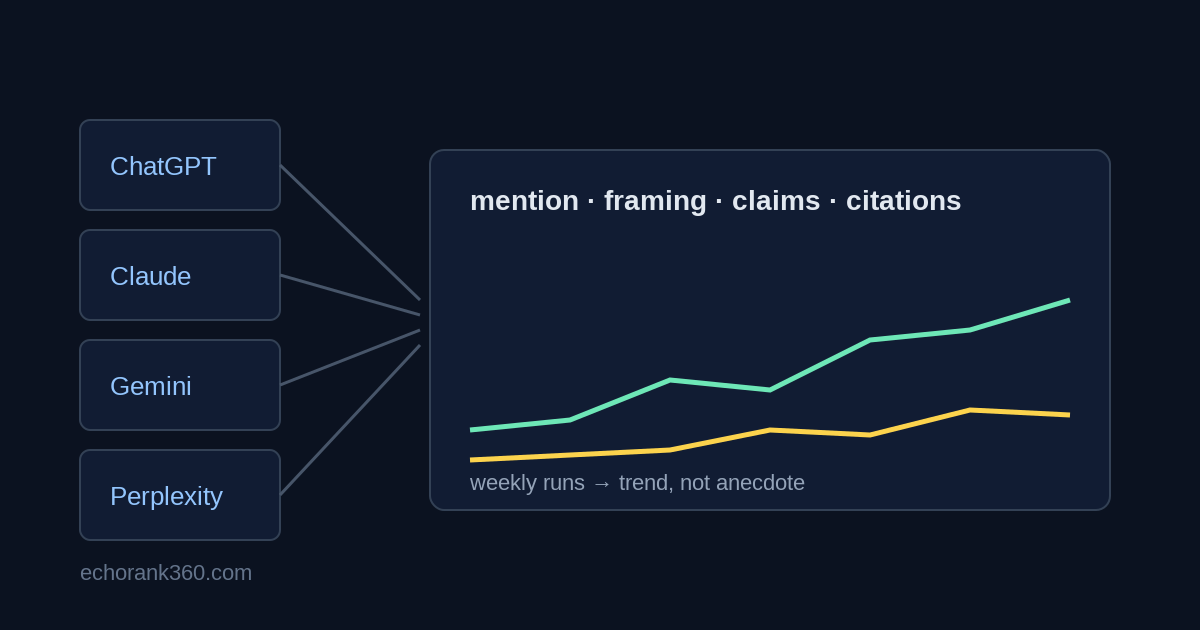
Platforms do not retrieve information the same way, and not every answer uses live search. That is why ChatGPT may recommend a business that Gemini leaves out. Visibility has to be measured per platform. See Where does ChatGPT get its answers? for a closer look at one of them.
How Google's AI answers are built
Google's AI Overviews and AI Mode sit on top of its existing search systems. For a complex question, Google can run several related searches behind the scenes, a technique it calls query fan-out, and build one answer from the results.
Example question: "What is the best reputation management software for a multi-location dental practice?"
Sub-searches the system could run:
- reputation management platforms
- healthcare review management
- multi-location business software
- Google Business Profile monitoring
- customer feedback tools
- pricing and features
The practical lesson: cover the whole of a customer's need, not one keyword. Google states that its normal SEO fundamentals still apply to these features. See Google's documentation on AI features.
A six-step plan
There is no formula that guarantees a place in an AI answer. You can make your information more accessible, accurate and credible, then check whether it worked.
- Set a baseline. Run an AI Visibility audit and track a set of prompts. Which platforms mention you? Where do competitors appear instead? Is the description accurate?
- Fix access. Use Nosy Bat and AI Lens to clear crawl, indexing, rendering, metadata and structured-data problems.
- Answer real questions. Publish comparisons, buying guides, service explanations, case studies and FAQs. Usefulness beats volume.
- Build reputation beyond your site. Earn independent coverage, keep listings accurate, collect real feedback.
- Watch competitors. Note who appears in answers about your industry and why. Use it to find your own gaps, not to copy.
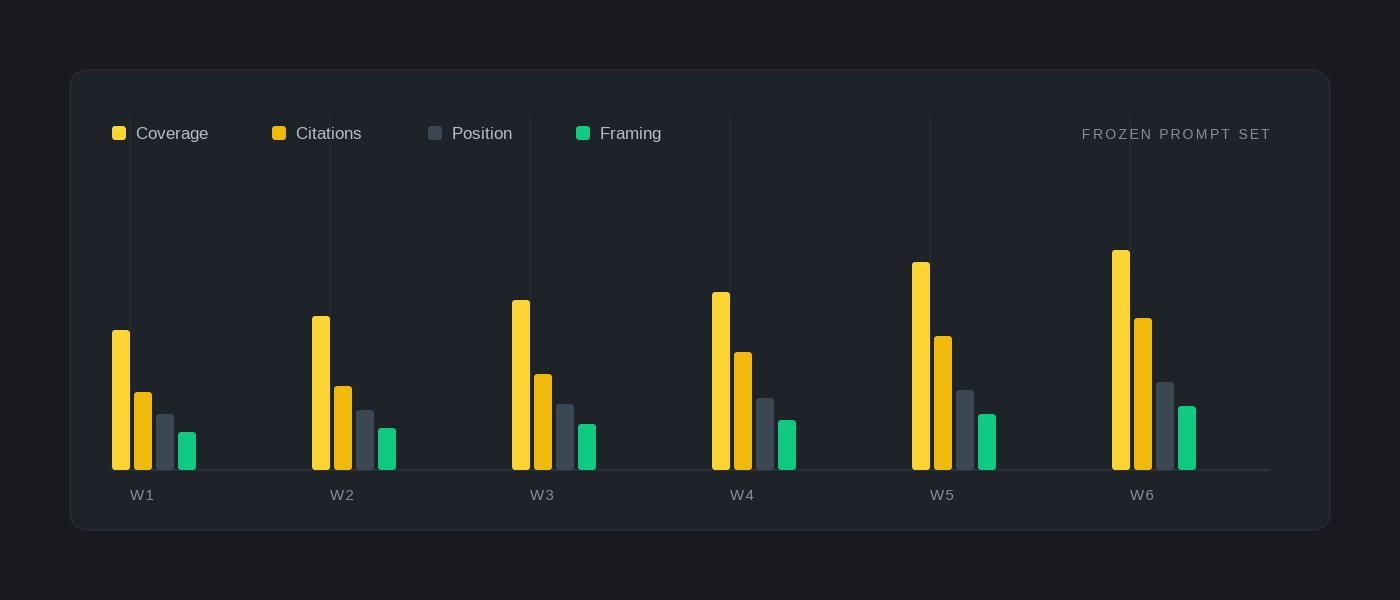
- Measure over time. One AI answer is a snapshot. Use the same prompt set and compare results. The method is in How to measure AI search visibility.
Measure: what to track
| Metric | What it tells you |
|---|---|
| AI Visibility Score | Overall presence in monitored answers |
| Brand mention rate | How often you appear |
| Citations | Which sources the answers reference |
| Recommendation position | Where you sit beside other brands |
| Competitor presence | Who appears instead of you |
| Prompt trends | Change for each tracked question |
| Customer feedback | Reputation issues to fix |
| Technical audit findings | Access and SEO problems |
Echorank runs your tracked prompts every day, can crawl your site on a schedule, and raises alerts when your visibility drops, so you see changes without searching by hand. To follow mentions across assistants, see Tracking brand mentions across LLMs.
What you can and cannot control
You can influence the information available to search engines and AI systems. You cannot guarantee how a platform will use it. AI answers can be out of date, incomplete or wrong, and they vary by platform and by prompt.
What helps: accurate official information, clear and verifiable content, corrected third-party profiles, credible outside recognition, regular monitoring, and using each platform's feedback tools when something is wrong.
Also remember what these systems cannot see: private documents, password-protected pages, content blocked from crawling, very recent pages, details buried in complex interactions, and anything that exists only offline. If your strongest selling points are in that list, AI has nothing to work with. Put them on a public, readable page.
See how AI describes your business
The question used to be "Where does my website rank?" It is now also "When a customer asks AI for a recommendation, am I in the answer?"
Run your free AI Readiness Audit. 7-day free trial on every plan, cancel anytime.
Frequently asked
Where does Google get its information?
From publicly accessible web pages, structured databases, information businesses submit, specialised data providers, public contributions and its own processing systems.
Where does ChatGPT get its information?
From what the model learned in training, what you tell it in the conversation, and external sources it retrieves when search or other tools are in use. Which of these apply depends on the model and features involved.
Does ranking first on Google guarantee AI visibility?
No. Strong rankings help discoverability, but AI recommendations depend on the platform, the question and what it retrieves. Measure the two separately.
Can customer reviews influence AI recommendations?
Public reviews can be retrieved or referenced by AI systems that have access to them. Real feedback also strengthens your wider reputation.
Is structured data required for AI visibility?
No. It can help systems that support it understand your pages, but it does not guarantee inclusion.
What is Generative Engine Optimization?
GEO is the practice of improving how discoverable and how well represented a brand is in AI-generated search answers. It combines technical SEO, content, authority, reputation and measurement.
How can I check whether AI recommends my business?
You can ask the assistants yourself, but each answer is a single snapshot. Echorank tracks chosen prompts, brand mentions, citations and competitor positions across supported AI platforms over time.