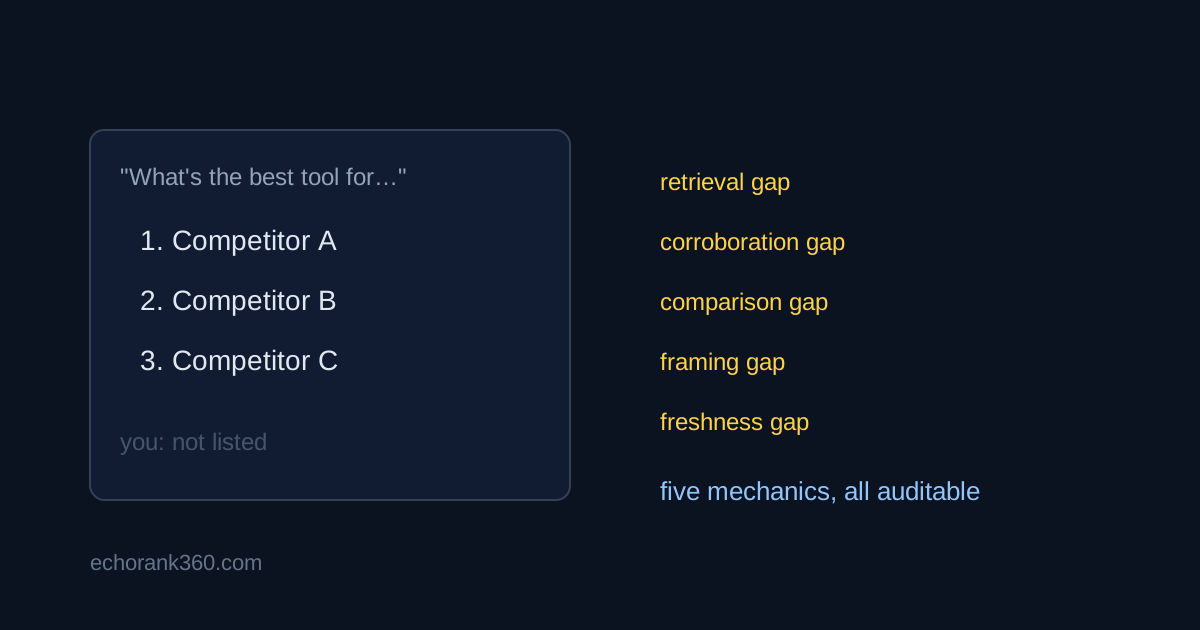
Ask ChatGPT for the best tool in your category and watch it name three competitors. Before treating that as a verdict on your product, understand what actually produced the list: a retrieval pass over indexed content, a synthesis step that leans on sources that agree with each other, and a strong preference for entities the system can describe confidently. Falling out of that process has five usual causes, and each one is diagnosable.
Gap 1: You are not retrievable
If the engine's crawlers cannot reach you, or your pages exist only as JavaScript that retrieval agents do not execute, or a robots.txt line from 2023 blocks the retrieval agent — you are not in the candidate pool, and nothing downstream matters. This is the first thing to rule out because it is the cheapest to fix and the most binary in effect.
Gap 2: Nobody else says what you say
Answer engines are corroboration machines. A claim that appears only on your own site is one voice; the same claim echoed by review sites, directories, industry posts and comparison articles is a fact the engine can repeat without hedging. Competitors who show up in recommendations almost always have a wider corroboration footprint — more independent pages describing what they do, for whom, at what price. This is the heaviest lever on the list and the slowest one to move.
Gap 3: You are absent from comparison content
A large share of commercial AI answers are synthesized directly from "best X for Y" and "A vs B" content, because those pages already have the answer's shape. If the comparison pages in your category omit you, the engine reproducing them omits you too. Getting included in existing roundups, and publishing genuinely useful comparisons yourself, moves this gap directly.
Gap 4: Your framing is vague
Engines recommend entities they can place: "the affordable option for small teams", "the enterprise pick", "the open-source alternative". If your positioning requires a paragraph of nuance — or your homepage describes you differently from your docs, which describe you differently from your LinkedIn — the system cannot compress you into a recommendation slot. Vagueness reads as risk, and risky entities get skipped, not hedged.
Gap 5: Your footprint is stale
Engines discount signals that look abandoned: copyright 2023 in the footer, a blog silent for a year, pricing pages that disagree with review-site listings from two funding rounds ago. Freshness is partly about dates and partly about agreement between your current claims and what the rest of the web still says about you.
Running the diagnosis
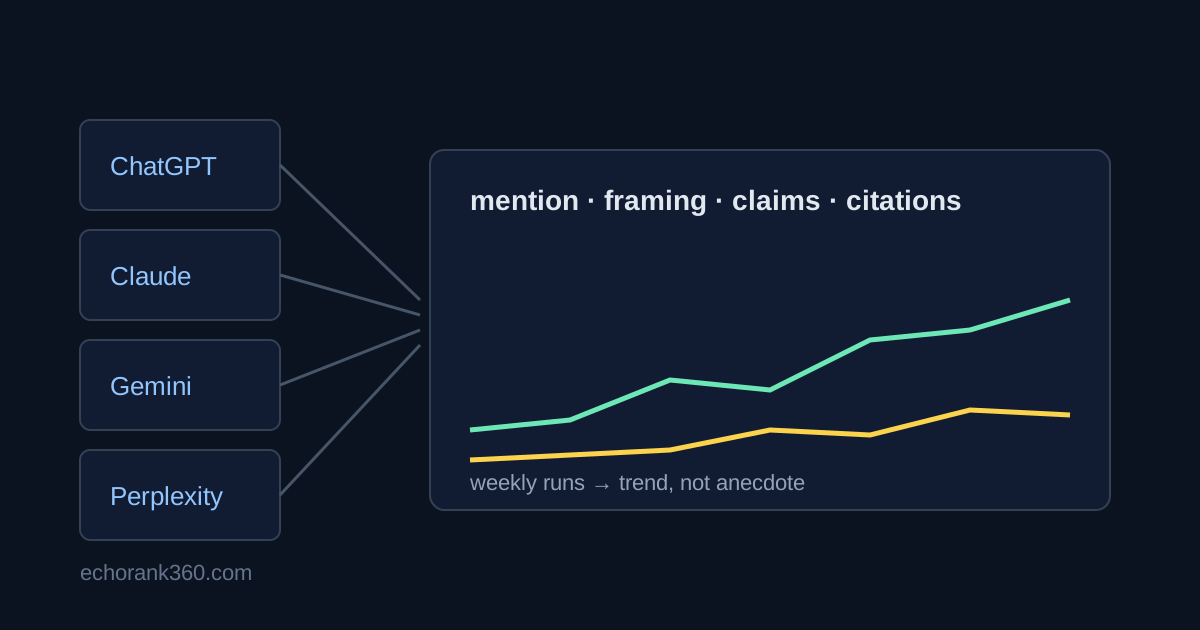
Take the five commercial questions your buyers actually ask. Ask them in clean sessions across ChatGPT, Perplexity and Gemini. For each answer, record who got named, and read the citations — the cited pages tell you which gap is operating. Competitors cited from comparison articles you're missing from is gap 3. Answers that describe competitors crisply and you not at all is gap 2 or 4. No trace of your content in any citation despite relevant pages existing is gap 1.
The list the AI gives is not a judgment. It is the output of a measurable process, and every stage of it can be audited.
Questions fréquentes
Is the AI biased toward big brands?
Larger brands have more third-party coverage, more comparison-page presence and more consistent descriptions across the web — which is what the assembly process rewards. That is a corroboration advantage, not a preference coded into the model.
How long does it take to show up in recommendations after fixing these gaps?
Retrieval-layer fixes can surface in days on engines with live search. Corroboration builds over weeks to months, because it depends on third-party pages being crawled and reindexed. Training-data effects take a model generation.
Should I just publish my own comparison page?
Yes, but as one input, not the fix. Your own comparison ranks for retrieval and frames the category in your terms. Engines still weight independent sources more heavily, so third-party presence remains the larger lever.