"Ranking" on ChatGPT is a slightly misleading idea. There is no page of ten results and no position one. There is an answer, and your brand is either mentioned in it, cited as a source for it, or absent.
The audience is large enough to care about. OpenAI said in February 2026 that ChatGPT had passed 900 million weekly active users. So the question is fair: what actually moves a brand into those answers?
Nobody outside OpenAI can see the system, so this guide sticks to what independent studies have measured. One caveat runs through all of it: these are correlations, not proof of cause. They tell you what visible brands have in common, which is still the best map available.
Mentioned vs cited: two different wins
| Mentioned | Cited | |
|---|---|---|
| What it looks like | Your brand name appears in the answer text | Your URL appears as a linked source |
| What drives it | How strongly the model associates you with a topic, built from training data and what it retrieves | Your page being retrieved, read and judged the best source for a specific point |
| What you get | Awareness, consideration, shortlist inclusion | A click opportunity plus credibility |
| Main lever | Reputation across the web | Specific, quotable, crawlable pages |
You want both, and they are won in different places.
What the data says about being mentioned
Off-site mentions beat links
The clearest signal so far comes from Ahrefs, which analysed 75,000 brands. In its study of Google AI Overviews, the factor most correlated with a brand being mentioned was branded web mentions across the web, at 0.664 (Spearman). Backlinks were far weaker at 0.218. The three strongest factors were all off-site: web mentions, branded anchor text and branded search volume.
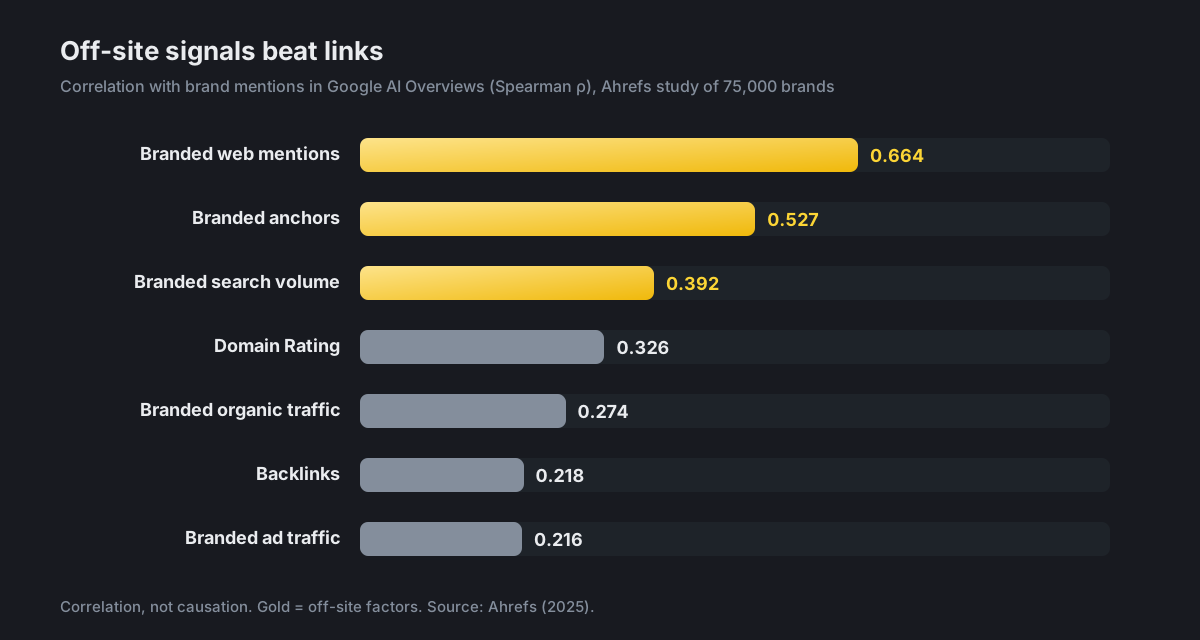
A follow-up study extended the analysis to ChatGPT and Google AI Mode and found the same pattern holding across platforms. It also found YouTube mentions to be the single strongest correlate, at about 0.74. Seer Interactive, looking at ChatGPT specifically, likewise found weak correlations for link metrics (around 0.25 for domain rank and 0.10 for backlinks).
What it means: being talked about matters more than being linked to. Ahrefs also noted that ChatGPT appears less gated by traditional SEO authority than Google's AI features, which is good news for smaller brands with a strong reputation in their niche.
Recognition isn't the same as recommendation
A Q2 2026 study by the agency Victorious tested eight AI platforms and found that 96% of brands were described accurately when asked about directly, yet far fewer were mentioned when the question was about the category. Being known is the easy part. Being recommended for "best X for Y" questions is where the competition is.
What the data says about being cited
A few domains take a big share
Citations are concentrated. Similarweb's January–February 2026 data for the US found Wikipedia and Reddit far ahead of everything else among domains cited by ChatGPT with browsing:
| Domain | Share of ChatGPT citations (US, Jan–Feb 2026) |
|---|---|
| wikipedia.org | 13.2% |
| reddit.com | 12.0% |
| openai.com | 6.2% |
| walmart.com | 2.9% |
| youtube.com | 2.7% |
| linkedin.com | 2.4% |
| reuters.com | 2.3% |
Kevin Indig's analysis of 1.2 million ChatGPT responses (March 2026) found the same concentration inside topics: about 30 domains took two thirds of citations. Yet 58% of cited URLs appeared only once. The long tail is real, and a specific, well-built page can still win.
Earned sources dominate
Muck Rack's May 2026 report found ChatGPT included citations in 96% of responses, with about five sources each. Around 99% of cited links came from non-paid sources, and journalism alone made up about a quarter of all citations. You cannot buy your way into the sources an assistant cites.
Citation patterns shift fast
Sources move. Several trackers reported that Reddit's and Wikipedia's share of ChatGPT citations fell sharply in September 2025, within a few weeks. Treat any "top sources" list as a snapshot, and measure your own category regularly.
The playbook: what to actually do
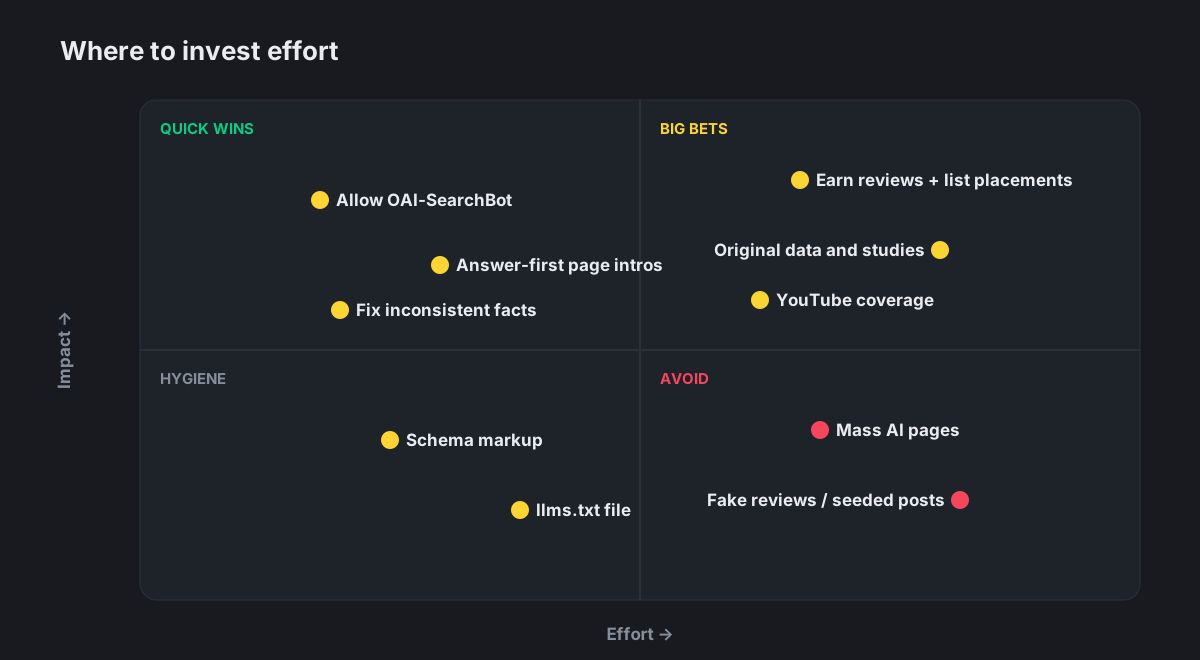
1. Build mentions where your buyers already look
Get reviewed, listed and discussed on the sites that show up in your category's answers: industry publications, comparison and "best of" lists, review platforms, YouTube reviews and relevant communities. Go for genuine coverage. Fake reviews or seeded threads tend to get caught and can damage the very reputation you're building.
2. Make your own pages the best source on your facts
For every commercial question you care about, have one page that answers it directly: a clear definition or verdict near the top, then specifics such as prices, limits, comparisons and steps. Pages with a short, self-contained answer are easier for an assistant to lift into a reply.
3. Publish things worth citing
Original data, benchmarks, calculators, templates and clear explanations of hard topics attract citations from journalists, bloggers and AI answers alike. A single solid study can earn mentions for years.
4. Stay reachable
Allow OAI-SearchBot (OpenAI's search crawler) in robots.txt and in any firewall or CDN bot rules, and make sure key content is in the server-rendered HTML. A brilliant page that the crawler can't read doesn't exist for ChatGPT search.
5. Keep your facts consistent everywhere
If your website, review profiles, directory listings and old press releases disagree on what you do or what it costs, the answer may pick the wrong version. Audit and align them.
6. Measure, then iterate
Track a fixed set of buyer questions over time: how often you're mentioned, in what position, beside which competitors, and which URLs are cited. Answers vary from run to run, so trends over weeks matter more than any single reply.
What doesn't work
| Tactic | Why it fails |
|---|---|
| Keyword-stuffing for "AI" | Assistants summarize meaning; repetition adds nothing |
| Mass AI-generated pages | Thin, interchangeable content is rarely the best source for anything |
| Fake reviews and seeded forum posts | Platform moderation and detection; reputational risk if exposed |
| Hidden text or prompt instructions aimed at AI | Treated as manipulation; can get pages ignored |
| Expecting one file or tag to fix it | No single markup guarantees mentions or citations |
Key takeaways
| Two wins | Mentions come from reputation; citations come from strong, reachable pages |
| Mentions > links | Branded web mentions and YouTube mentions correlate most with AI visibility |
| Concentrated but open | A few domains dominate, but most cited URLs appear only once |
| Earned, not bought | Around 99% of cited links come from non-paid sources |
| Measure trends | Answers vary; track a fixed question set over time |
Further reading
- Where Does ChatGPT Get Its Answers? A Plain-English Guide for Businesses
- How to Optimize for AI Search: A Guide for You and Your AI Agent
- How to Monitor Brand Mentions in ChatGPT
- The ChatGPT Traffic Playbook: How to Track, Measure, and Grow
- AI Visibility Audit: How to Measure Your Brand's Presence in AI Search
Find out where you stand. Run a free AI visibility audit, then compare Echorank plans to track your mentions, competitors and cited sources across ChatGPT and other AI engines every week.
Sources
- OpenAI via Search Engine Land: ChatGPT statistics
- Ahrefs: An analysis of AI Overview brand visibility factors (75K brands)
- Ahrefs: Top brand visibility factors in ChatGPT, AI Mode and AI Overviews
- Search Engine Journal: AI recognizes 96% of brands but mentions almost none (Victorious)
- Similarweb: The most cited domains by LLMs
- Muck Rack: What is AI reading? (May 2026)
- LLM Pulse: How to get your brand cited by ChatGPT (summarizing Kevin Indig's analysis)
Editor: Frederic Desjardins - Echorank