Ask ChatGPT for "the best project management tool for a small agency" and you get a confident, well-structured answer in seconds. Brands get named. Some get praised and some get left out. Behind that answer is a question every marketer should be asking: where did that information come from, and why was my company (or my competitor) in it?
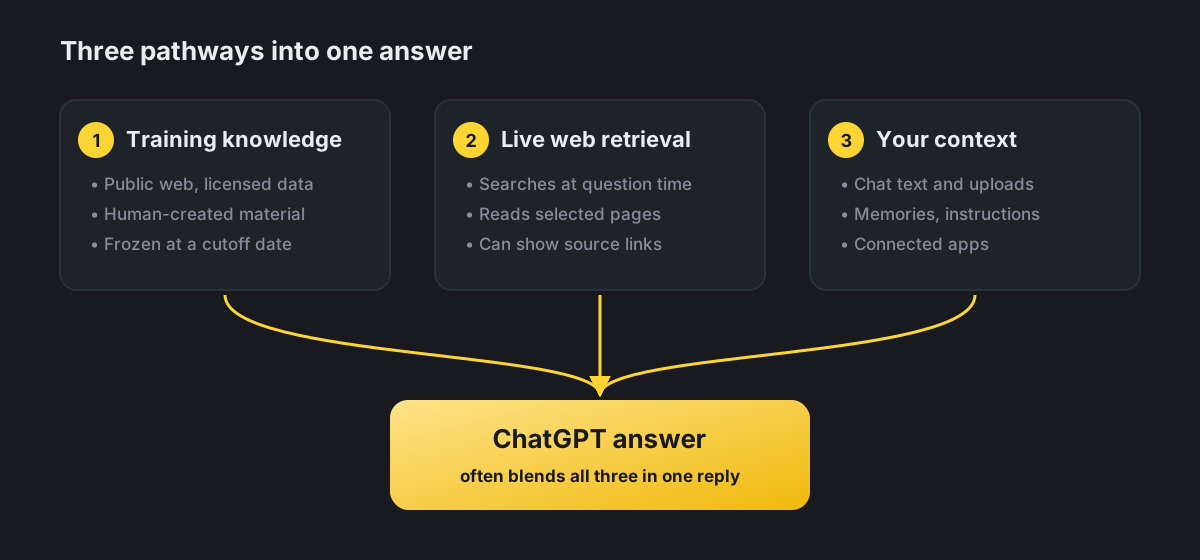
The short answer is that ChatGPT draws on three different information pathways, and it often mixes them inside a single reply. Once you understand them, AI visibility stops feeling like a black box and starts looking like something you can work on.
Pathway 1: What the model learned in training
Before ChatGPT ever talks to anyone, the underlying language model is trained on a very large body of text. According to OpenAI, that includes publicly available content from the web, data licensed from partners, and material created by human trainers and researchers.
The important thing to understand is what training produces. The model does not keep a library of web pages it can look things up in. It learns patterns: which concepts go together, how topics are usually explained, which names tend to come up in which categories. When it explains what a "content calendar" is without searching for anything, it is drawing on those learned patterns.
That has two consequences for businesses:
- Old impressions stick. If your company was described a certain way across the web when the model was trained, that description can come back long after you have changed your product, pricing, or positioning.
- The model has a cutoff. Training knowledge does not update itself when you publish something new. Anything that happened after the cutoff only reaches the answer through the next pathway.
Pathway 2: What it finds on the live web
When a question depends on fresh information (current prices, new releases, "best tools right now", recent news), ChatGPT can run a web search before it answers. This is where things get interesting for brands, because this pathway is live, citable, and something you can influence.
The process works like a research assistant on a deadline rather than a single lookup:
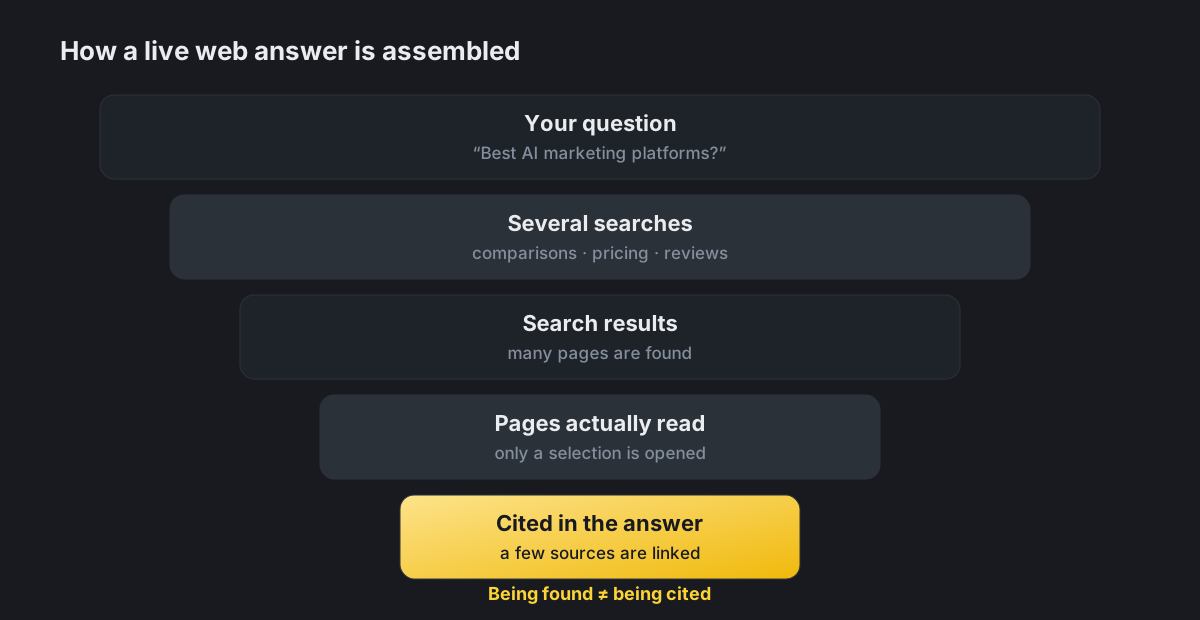
- It rewrites the question into several searches. A single prompt like "best AI marketing platforms" might turn into separate searches for comparisons, pricing pages, and reviews.
- It reads a selection of results. Only some of the pages returned are actually opened and used.
- It writes an answer from what it read, blended with what it already knew.
- It shows sources. When web search is used, the answer can include links so the reader can check the original pages.
The key lesson sits in the narrowing shape of that funnel: being found is not the same as being cited. Your page can appear in the search results ChatGPT looks at and still never make it into the final answer, because a clearer, more specific, or more trusted page covered the same point better.
Pathway 3: What you hand it
The third pathway is the most personal. ChatGPT can also answer from information the user supplies, depending on the features and permissions in place:
- Text pasted into the conversation
- Uploaded files such as PDFs, spreadsheets or images
- Saved memories and custom instructions
- Data from connected apps the user has authorised
If someone uploads your competitor's brochure and asks "how does this compare to Echorank?", the answer is shaped heavily by that document. Businesses cannot see or control this pathway, which is one more reason to make the public picture of your brand as clear as possible.
The three pathways side by side
| Training knowledge | Live web retrieval | User-provided context | |
|---|---|---|---|
| Where it comes from | Public web, licensed data, human-created training material | Search results fetched at question time | Chat text, uploads, memories, connected apps |
| How fresh it is | Frozen at the training cutoff | As fresh as what is published and indexed | As fresh as what the user supplies |
| Shows sources? | No | Usually, as links | Refers to the user's own material |
| Can a business influence it? | Slowly and indirectly, through a consistent public footprint over time | Yes: content, structure, crawler access, third-party coverage | No |
| Biggest risk for brands | Outdated or wrong descriptions that persist | Being retrieved but not cited, or a competitor's page being cited instead | A one-sided document framing the comparison |
Not every source carries the same weight
Whether an answer comes from training or from a live search, the quality of the underlying sources matters. A manufacturer's spec sheet is authoritative on specifications. An independent reviewer is more useful on real-world performance. Government, academic and professional bodies carry weight on regulated or technical questions.
A good AI answer should separate facts from estimates and opinions, but language models still make mistakes. They can misread a source, merge details from different companies, or miss important context. Treat an AI answer as a well-informed starting point, not as verified fact, and check anything important against the primary source. That applies to your customers reading about you, and to you reading about your competitors.
Publishers and content partnerships
Some professionally produced content reaches ChatGPT through commercial agreements between OpenAI and publishers. These deals can let news and editorial content appear with summaries, attribution and links back to the original reporting.
For publishers this opens a new route to readers. For everyone else, it is a reminder that relevance still decides: a partnership makes content available, but an article only appears in an answer when it actually fits the question being asked.
The crawlers behind ChatGPT, and what each one does
If you want your site to be eligible for ChatGPT's live answers, it helps to know which OpenAI bots visit and why. They are separate, and you can allow or block each one on its own in robots.txt.
| User agent | What it does | Controlled by robots.txt? | What it means for you |
|---|---|---|---|
| OAI-SearchBot | Crawls pages so they can be surfaced in ChatGPT's search features | Yes | Allow it if you want to be eligible for live, cited answers |
| GPTBot | Crawls content that may be used to train future models | Yes | Blocking it opts you out of training without affecting search eligibility |
| ChatGPT-User | Fetches a page when a user's action requires it, such as visiting a link they asked about | Not reliably: these visits are user-initiated | Not used to decide search eligibility |
| OAI-AdsBot | Reviews landing pages submitted as ads | Not stated | Only relevant if you advertise on OpenAI platforms |
A few practical notes from OpenAI's crawler documentation:
- The settings are independent. You can allow OAI-SearchBot for visibility and disallow GPTBot to opt out of training.
- Changes are not instant. OpenAI says search-related robots.txt changes can take about 24 hours to take effect.
- Firewalls count too. If your CDN or firewall blocks OpenAI's published IP ranges, a friendly robots.txt will not help.
Allowing the right crawler makes you eligible. It does not guarantee you will be included or cited.
What this means for your business
AI assistants are becoming a normal step in how people research products, compare vendors and shortlist companies. A customer who used to open ten tabs may now read one AI-generated comparison. That shifts the question from "do we rank?" to "can an AI assistant find us, understand us, and describe us accurately?"
Four habits make the biggest difference.
1. Make your website the clearest source about you
Spell out what you sell, who it is for, what it costs and how it compares. Put key facts on dedicated, crawlable pages rather than in PDFs, images, or text that only appears after JavaScript runs. Keep pricing and feature pages current: an AI that reads an outdated page will repeat an outdated answer.
2. Earn credible mentions elsewhere
AI answers lean on more than your own site. Reviews, industry publications, comparison articles and expert discussions all shape how you are described. A consistent, well-supported reputation across independent sources gives an assistant more than one reason to include you.
3. Keep the door open to the right crawlers
Check your robots.txt, CDN rules and firewall for accidental blocks on OAI-SearchBot and the equivalent crawlers of other AI engines. Make sure your most important pages render their content in the HTML an AI crawler actually receives.
4. Measure what AI actually says about you
You cannot improve what you do not check. Ask the same buyer-style questions on a regular schedule and track the answers.
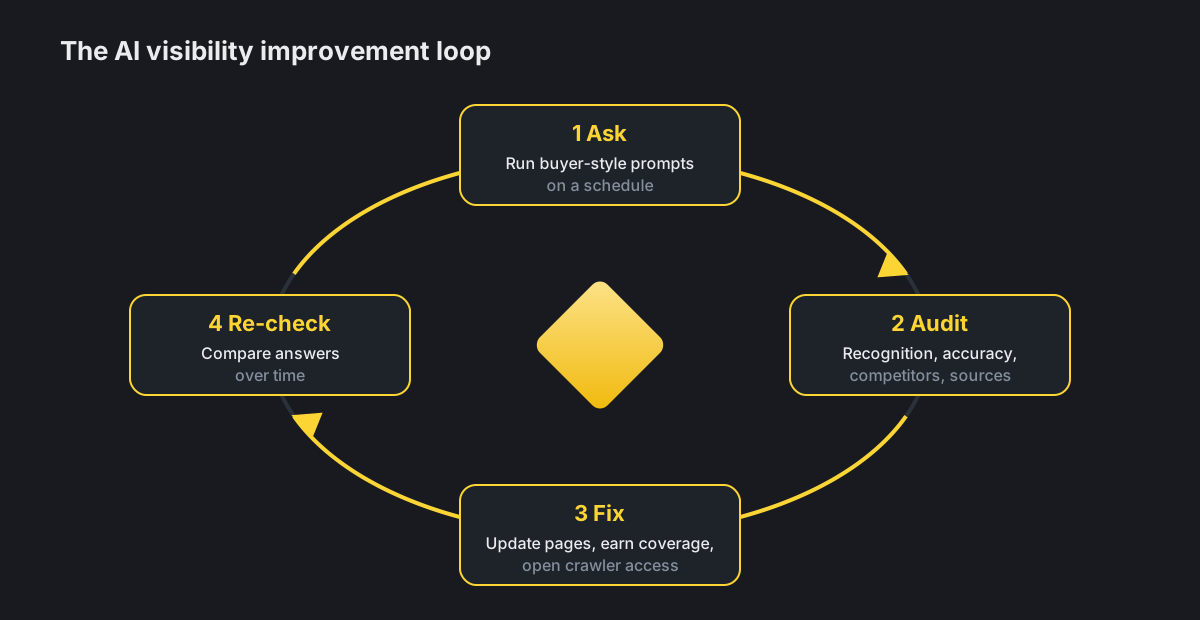
| What to check | What to look for | Typical fix |
|---|---|---|
| Recognition | Does the assistant know your company when asked directly? | Clear About and product pages, consistent naming everywhere |
| Accuracy | Are features, pricing and positioning described correctly? | Update stale pages, correct outdated third-party listings |
| Share of answer | How often are you named in category questions ("best X for Y")? | Comparison and use-case content, more independent coverage |
| Competitors | Who is named instead of you, and on which questions? | Target the gaps with focused pages and evidence |
| Cited sources | Which URLs does the assistant link to when it mentions you? | Strengthen the pages that get cited and fix the ones that mislead |
| Crawler access | Can AI crawlers reach and read your key pages? | Fix robots.txt, firewall rules and JavaScript-only content |
Can you control what ChatGPT says about you?
Honestly, no, and you should be wary of anyone who promises otherwise. Answers depend on how the question is phrased, what the model learned, what a search turns up on the day, and what the user supplies. Two near-identical questions can produce different answers.
What you can control is the quality, accuracy and accessibility of the information available about you. Publish clear facts, fix what is out of date, open the door to the right crawlers, and earn genuine third-party coverage. The goal is trustworthy visibility: being the obvious, well-documented answer when your category comes up, rather than trying to game a single recommendation.
Key takeaways
| Three pathways | Training knowledge, live web retrieval and user-supplied context, often blended in one answer |
| Found ≠ cited | Appearing in search results does not mean appearing in the answer |
| Crawlers are separate | OAI-SearchBot governs search eligibility; GPTBot governs training. Configure each on purpose |
| No guarantees | Nobody can promise a mention, but clear, current, well-supported information improves your odds |
| Measure regularly | Track recognition, accuracy, share of answer, competitors and cited sources over time |
Further reading
- How to Optimize for AI Search: A Guide for You and Your AI Agent
- How to Rank on ChatGPT: What Actually Works (Based on Data)
- How to Monitor Brand Mentions in ChatGPT
- The ChatGPT Traffic Playbook: How to Track, Measure, and Grow
- AI Visibility Audit: How to Measure Your Brand's Presence in AI Search
See what AI says about your brand today. Run a free AI visibility audit to check how AI engines read your site, or compare Echorank plans to track your brand across ChatGPT and other AI engines every week.
Sources
- OpenAI: How ChatGPT and our foundation models are developed
- OpenAI: Searching the web with ChatGPT
- OpenAI: Overview of OpenAI crawlers
- OpenAI: Introducing ChatGPT search
Editor: Frederic Desjardins - Echorank